Symptoms and background
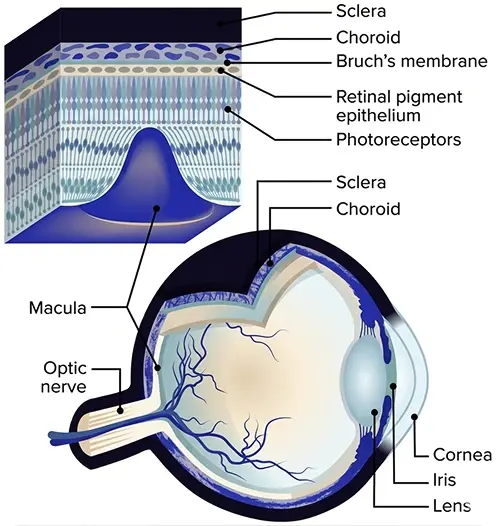
Age-related macular degeneration (AMD) is the most common cause of severe visual impairment in people over 50 in Switzerland. It affects the central area of the retina (the macula), which is responsible for sharp, detailed vision.
Typical symptoms of dry AMD are dark patches in the centre of the visual field, as well as increasing difficulty reading and recognising faces.
With wet AMD, distorted vision is added (straight lines appear wavy); the symptoms often appear suddenly and can deteriorate rapidly. It is the more severe form and requires immediate treatment. Neither form causes pain.
What modern medicine can do
There is currently no approved therapy for dry AMD. Certain dietary supplements (the AREDS2 formula) can, however, slow the progression of the condition. Regular check-ups are essential here.
For wet AMD, anti-VEGF injections (injections into the vitreous body) are the established standard of treatment. Medications such as ranibizumab, aflibercept or faricimab inhibit the growth of abnormal blood vessels – and in many cases noticeably stabilise vision.
We offer this treatment at all six locations. The injections are minimally invasive, are given under local anaesthetic and take only a few minutes.
Strengths Strengths of Argus Augenklinik
Personal support
Long-term care for chronic conditions such as AMD – personal and tailored to your situation
Early-detection screening
Detecting the early stages of AMD – often before symptoms become noticeable
Close monitoring
Regular OCT examinations for precise monitoring and adjustment of your therapy
Modern medications
Ranibizumab, aflibercept, faricimab – matched individually to your situation
Anti-VEGF therapy at all locations
Treatment close to you – with no long journeys to the hospital
Treatment process
-
Initial examination & OCT diagnosis
We examine your retina in detail using OCT (optical coherence tomography) in order to assess the macula precisely. -
Treatment planning
Depending on the form and stage of the AMD (dry or wet), we discuss the optimal treatment plan with you. -
Anti-VEGF injection (for wet AMD)
We inject the active substance into the vitreous body under local anaesthetic. The procedure takes only a few minutes and is usually well tolerated. The treatment has to be repeated at intervals. -
Regular follow-up appointments
Depending on the findings, check-ups take place roughly every four to eight weeks. We monitor progress using OCT and decide on any further injections.


Frequently asked questions
Can I still drive with AMD?
That depends on the stage of the condition and your remaining vision. We assess this individually and advise you accordingly.
Does health insurance cover the costs?
Yes – anti-VEGF treatment for wet AMD is covered by health insurance.
Does the injection hurt?
The eye is numbed with drops before the injection. Most patients feel only a slight sensation of pressure, but no pain.
How often do I need an injection?
That depends on the findings. Usually monthly at the start, and later every weeks. Your doctor will discuss the rhythm with you and adjust it regularly.
Is AMD curable?
AMD cannot be cured, but its progression can be slowed. Wet AMD can usually be stabilised with anti-VEGF injections and converted into a dry form of AMD.