Symptoms and background
From about the age of 45, the natural lens of the eye increasingly loses its elasticity – near vision becomes more difficult and reading glasses become necessary. This age-related long-sightedness (presbyopia) affects practically everyone.
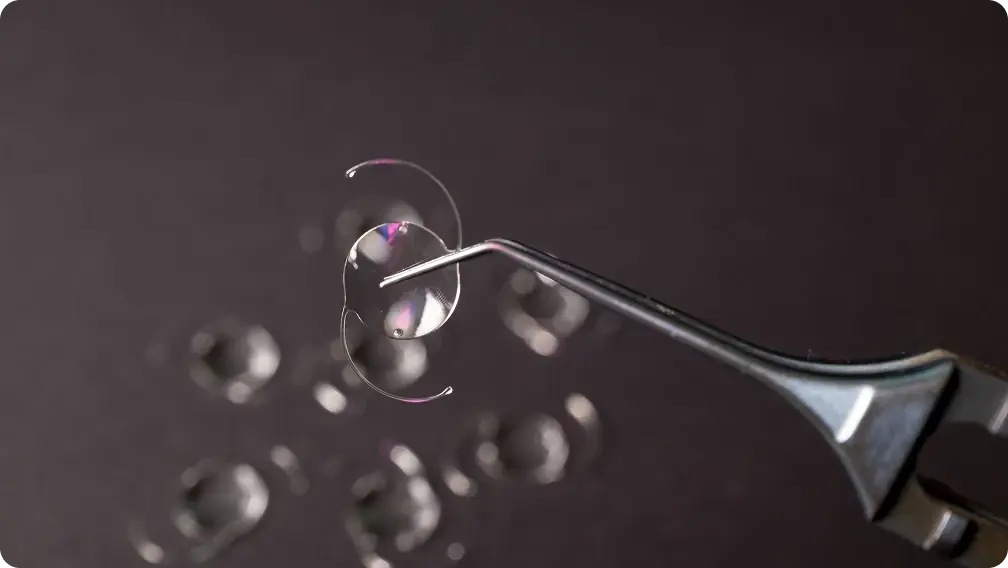
Refractive lens exchange (RLE) – also known as clear lens exchange (CLE) – replaces the natural lens with an artificial one. Short-sightedness, long-sightedness and astigmatism can be corrected at the same time.
An additional benefit: because the natural lens is removed, a cataract can no longer develop later on.
What modern medicine can do
Refractive lens exchange is based on the same procedure as cataract surgery – with the difference that the lens is still clear and the procedure is carried out to correct vision.
Various artificial lenses are available: monofocal lenses for one viewing distance, trifocal lenses for near, intermediate and distance vision, and toric lenses to correct astigmatism.
Modern trifocal lenses allow many patients to become completely free of glasses.
The procedure is minimally invasive and carried out through a very small incision. It is performed on an outpatient basis and involves a short recovery time.
Strengths of Argus Augenklinik
Freedom from glasses at three distances
Trifocal premium lenses allow many people complete freedom from glasses for near, intermediate and distance vision
Cataracts prevented
Once the lens has been exchanged, a cataract can no longer develop
A proven procedure
The same technique as cataract surgery, which is performed thousands of times a day worldwide.
Minimally invasive
A very small incision, outpatient, very fast healing
Individual lens consultation
Tailored to your personal vision needs and your everyday life
Treatment process
-
Preliminary examination & consultation
Biometry, corneal measurement, refraction: we examine your eyes comprehensively and take the time to discuss the right lens solution with you. -
2. Choice of lens
Together we choose the artificial lens that suits you – monofocal, trifocal or toric. -
3. The procedure
We carry out the procedure on an outpatient basis under local anaesthetic. It takes about 15–20 minutes per eye. The eyes are treated about a week apart. -
4. Check-up the following day
We check your vision and how your eyes are healing. -
5. Aftercare
You use eye drops for about four weeks. We continue to support you with check-ups after one week, one month and three months.

Frequently asked questions
Does health insurance cover the costs?
Not for a purely refractive indication – that is, a lens that is still clear.
Are halos or rings of light after surgery normal?
Some people report halos around light sources at night in the period just after the procedure. In most cases, the brain adapts to this within a few months.
What is the difference from cataract surgery?
The procedure is identical. The difference: with a cataract the lens is clouded (a medical condition), with RLE it is still clear (an elective procedure to correct vision).
Will I really be free of glasses afterwards?
With trifocal lenses, the majority of patients are free of glasses in everyday life. For very small print or very dark surroundings, light glasses can still be helpful.
From what age does RLE make sense?
From about 45–50, when presbyopia becomes bothersome and laser eye surgery no longer offers an optimal solution.