Symptoms and background
Orthoptics (the vision school) specialises in examining and treating vision problems in children. Common reasons are amblyopia (a lazy eye), a squint (strabismus), double vision or delayed visual development.
Amblyopia develops when one eye is used too little in early childhood – for example because of a squint, because the two eyes have different prescriptions, or because of a visual impairment such as a congenital cataract or a drooping eyelid (ptosis). During this period, the brain learns to suppress the affected eye.
Early treatment is decisive: the sooner vision problems are detected, the better the chances of normal visual development. The most important phase lies between the ages of one and eight.
What modern medicine can do
Amblyopia is usually treated by temporarily covering the stronger eye (occlusion) so that the weaker one is trained specifically. Glasses or contact lenses are used in addition.
For a squint, prism glasses, occlusion or surgery may be necessary, depending on the findings. Find out more.
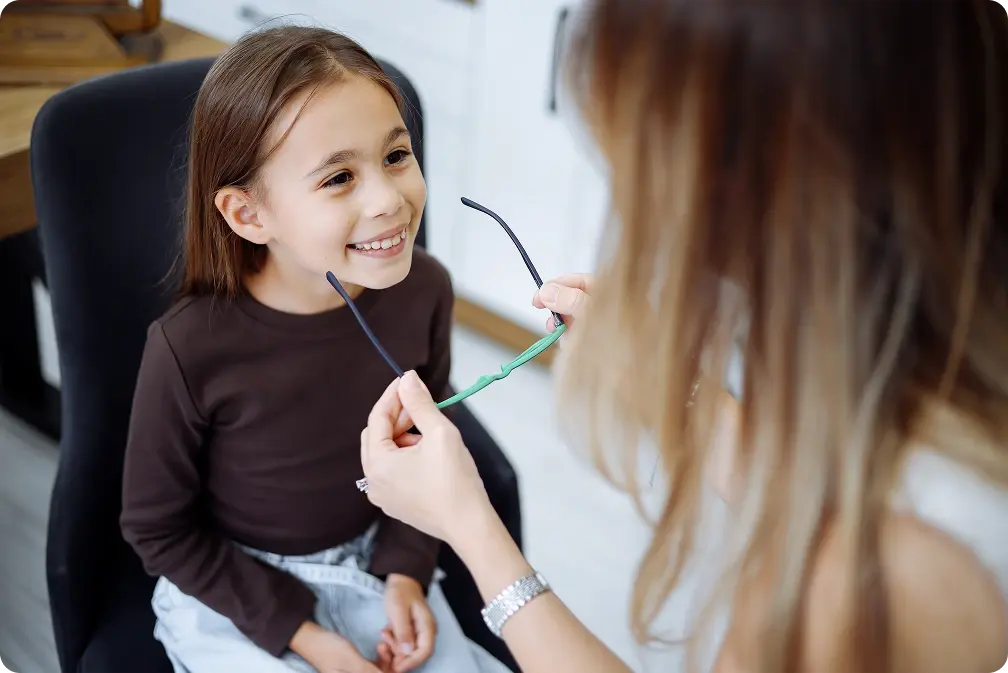
In our vision school, specially trained orthoptists work closely with our ophthalmologists. Playful exercises and child-friendly methods help to make vision training easy for children to understand and to follow.
Strengths of Argus Augenklinik
Specialised orthoptists
Experienced in paediatric ophthalmology and vision training
Child-friendly examination methods
Age-appropriate tests – even for toddlers
Close cooperation with our ophthalmologists
Short distances, direct communication, joint treatment planning
Parents involved
Clear guidance on supporting the therapy at home and in everyday life
Early detection
We recommend a first screening from the age of three
Treatment process
-
1. First appointment & child-friendly preliminary examination
We check visual acuity, eye alignment and eye movement. Where necessary, we measure the refractive error using eye drops. -
2. Discussing the findings with the parents
We explain the results in clear language and agree on the right treatment plan together. -
3. Start of therapy
We begin with the appropriate treatment – for example glasses, occlusion therapy or targeted orthoptic exercises. -
4. Regular check-ups
We review progress every six to 12 weeks and adjust the therapy at regular intervals.
Frequently asked questions
Does my child have to wear glasses?
Not always – but glasses are often part of the therapy. We advise you on choosing child-friendly frames.
What does the vision school cost?
Examinations and treatments at the vision school are generally covered by health insurance.
Can amblyopia still be treated in adulthood?
It is most effective in childhood. In adults, the results are more limited, but not impossible – the cause of the amblyopia should be investigated.
How long does my child have to wear the eye patch (occlusion)?
That depends on the severity of the amblyopia. Usually a few hours a day, over months or years. Consistency is decisive here.
From what age can my child attend the vision school?
We examine children from infancy. We recommend a first vision screening by the age of three at the latest.