Symptoms and background
Many eye conditions develop unnoticed for a long time – without pain and without clear signs. Even serious conditions such as glaucoma, macular degeneration or diabetic retinal changes are often only detected once they are already advanced.
A regular eye examination with a specialist is therefore the most effective form of prevention. Particularly recommended: every two years from the age of 40, annually from the age of 60, and earlier if you have risk factors such as diabetes, a family history of eye disease or short-sightedness of more than 6 dioptres.
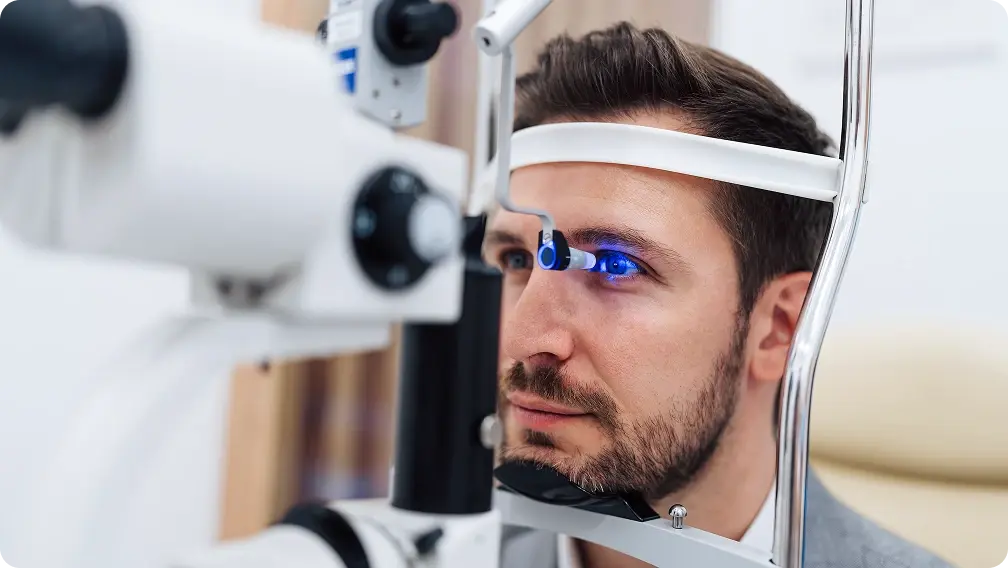
During a comprehensive eye examination, we assess, among other things, your visual acuity, your intraocular pressure and the anterior and posterior segments of the eye, the optic nerve and the retina.
What modern medicine can do
Modern examination methods such as optical coherence tomography (OCT) allow us to detect even the smallest changes in the retina at an early stage – often long before any symptoms appear.
For a complete assessment, we dilate the pupil with eye drops where necessary. This allows us to examine the posterior segment of the eye in detail. Please do not plan to drive afterwards, and bring a pair of sunglasses with you.
Strengths of Argus Augenklinik
Modern equipment for precise diagnostics
OCT, slit lamp, digital fundus camera, fluorescein angiography, ultrasound and visual field testing.
A clear discussion of the findings
Enough time to explain the results and our recommendations clearly
A focus on early detection
Screening for glaucoma, AMD, cataracts and retinal changes
Short waiting times
Appointments usually within a few days
Six locations – close to you
Easy to reach throughout Central Switzerland
Treatment process
-
Medical history
We discuss your symptoms, risk factors, medication and, where relevant, your family medical history -
Visual acuity test
We determine your current visual acuity for distance and near vision. -
Intraocular pressure
We measure the pressure inside the eye – without contact or with light contact. -
Slit lamp examination
We assess the anterior segment of the eye, such as the cornea, lens and vitreous body. -
Fundus assessment
We examine the retina, macula and optic nerve – with a dilated pupil if necessary. -
Discussion of findings & recommendation
We explain the results in clear language and discuss the next steps with you.

Frequently asked questions
From what age should I have regular check-ups?
We recommend an examination every two years from the age of 40 and annually from the age of 60. Earlier and more often if you have risk factors.
Does health insurance cover the eye check?
Yes – if there is a medical indication.
Do I need to have my eye check with a specialist?
An optician mainly measures visual acuity. Eye conditions such as glaucoma or macular degeneration can only be reliably detected through an ophthalmic examination.
Can I drive afterwards?
If your pupils have been dilated, please do not drive yourself. Arrange for someone to accompany you or plan your journey by public transport.
How long does an eye check take?
A complete check takes about 30 minutes. Allowing for the waiting time while the pupils dilate, please plan for 45 minutes.