Symptoms and background
The retina is the light-sensitive layer inside the eye – it works like the ‘film’ of your visual system. Retinal diseases and inflammation of the retina can permanently impair vision and require prompt, expert assessment.
Common retinal diseases include retinal detachment (amotio retinae), macular hole, macular pucker (gliosis), diabetic retinopathy, retinal vein occlusion and age-related macular degeneration (AMD).
Warning signs that should be assessed immediately: sudden flashes of light, a shadow or ‘curtain’ in the visual field, a marked increase in floaters (mouches volantes) or sudden loss of vision.
What modern medicine can do
Modern retinal surgery makes it possible to preserve or improve vision in many cases. Early diagnosis is decisive.
Depending on the findings, we use surgical procedures such as vitrectomy (vitreous surgery), laser treatment, cryopexy or scleral buckling for retinal detachment, as well as intravitreal injections (anti-VEGF) for vascular diseases.
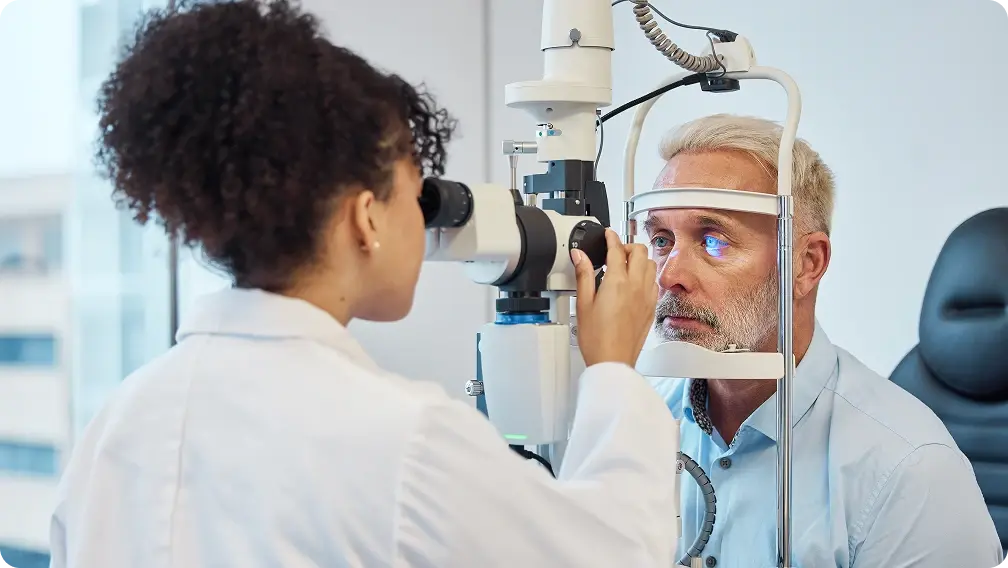
At Argus Augenklinik, we rely on precise retinal diagnostics using OCT, fluorescein angiography and ultrasound. Our surgeons are also specialised in complex retinal procedures.
Strengths of Argus Augenklinik
High-resolution OCT diagnostics
Detailed imaging of the retina – for precise diagnoses
Emergency assessment available
Immediate assessment if retinal detachment is suspected
Specialised retinal surgeons
Experience with complex procedures such as vitrectomy and scleral buckling
Anti-VEGF therapy at all locations
Treatment of vascular retinal diseases – as close to you as possible
Early detection in diabetes
Regular retinopathy screening for the early detection of diabetic changes
Treatment process
-
Emergency assessment or routine appointment
In case of acute symptoms, please call us immediately: we respond straight away with a rapid assessment. For chronic complaints, we arrange an appointment promptly. -
Detailed diagnostics (OCT, angiography)
We examine your retina using imaging procedures in order to assess the findings precisely. -
Treatment planning & information
We explain the findings and the appropriate treatment options in clear language and without jargon. -
Treatment (laser, surgery, injection)
Depending on the condition, this involves laser treatment, an injection of medication or a surgical procedure. -
Aftercare & long-term monitoring
We monitor progress closely and continue to support you reliably after treatment.


Frequently asked questions
Does health insurance cover the costs?
Yes – retinal treatments are covered by health insurance.
Is the treatment painful?
Laser treatments and injections are carried out under anaesthetic and are barely painful. Operations are performed under local or general anaesthetic.
Can vision return to normal after a retinal detachment?
Often yes – if surgery is performed quickly. The longer the retina is affected, the poorer the prognosis. Speed is decisive.
What are floaters (mouches volantes)?
Small opacities in the vitreous body that are perceived as threads or dots. Usually harmless, but a sudden increase should be assessed.
Is a retinal detachment an emergency?
Yes – a retinal detachment is an ophthalmic emergency. If you experience sudden flashes of light, a shadow in your visual field or severe loss of vision, please call us immediately or go to an emergency department.