Symptoms and background
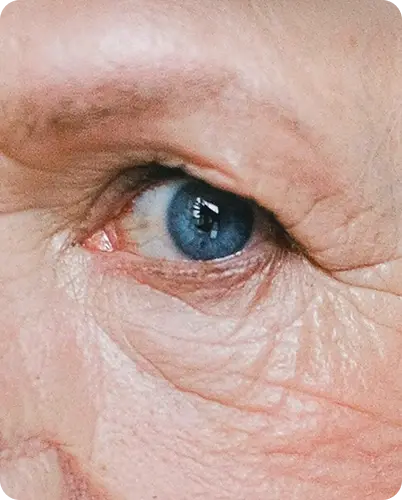
Drooping or heavy upper eyelids can be caused both by sagging skin (hooded eyelids) and by a lowering of the lid itself (ptosis). They affect not only your appearance but can also restrict your field of vision. If the upper lid covers the centre of the pupil, this is also medically relevant.
Hooded eyelids usually develop through the age-related loss of skin tension and muscle strength. Sagging lower lids – with or without eye bags – are also common.
Typical complaints are a tired-looking gaze, a feeling of heaviness in the lids, headaches caused by constantly raising the eyebrows and – in pronounced cases – a restricted field of vision.
What modern medicine can do
Eyelid correction (blepharoplasty) is one of the most common aesthetic procedures worldwide and serves to improve both the function and the appearance of the eyelids. If there is a medical restriction of the visual field, the procedure may be covered by health insurance.
In upper eyelid correction, excess skin and fatty tissue is removed where necessary. The scar lies in the natural lid crease and is barely visible afterwards.
In lower eyelid correction, eye bags and sagging skin are treated. Depending on the findings, access is either through the skin directly below the lashes or from the inside of the lid, so that here, too, the scar is barely visible or not visible at all.
Strengths of Argus Augenklinik
Medically and aesthetically grounded
Treatment of functional and cosmetic concerns
Specialist ophthalmic expertise
Eyelid surgery is part of our core ophthalmic competence
A natural-looking result
A fresh, alert expression without changing who you are
Discreet scar placement
The incision is barely visible once healed
Outpatient & gentle
Local anaesthetic and a short, fast recovery
Treatment process
-
1. Consultation & examination
We assess the eyelids, document the findings and clarify your expectations as well as the medical indication. -
2. Planning & marking
On the day of surgery, we mark the areas to be treated precisely – with your eyes open and closed. -
3. The procedure
We carry out the procedure under local anaesthetic. Excess skin is removed, and the skin is closed with fine sutures. It takes about 30 to 60 minutes. -
4. Cooling & brief observation
We cool the eye area immediately after the procedure. After a short observation period of about one hour, you can go home. -
5. Suture removal & check-up
We remove the sutures after about five to seven days. Swelling and bruising usually subside within two to three weeks.

Frequently asked questions
Does health insurance cover the costs?
Yes – if there is a medical indication (ptosis with a restricted visual field). Not for a purely cosmetic indication.
When can I go back to work?
After about seven to 10 days – with sunglasses, or once the swelling is no longer bothersome.
How long will my eyes be swollen?
After about two to three weeks, the swelling has largely subsided. The final result becomes visible after three to six months.
What does the result look like?
A fresh, alert gaze. We show you before-and-after examples and discuss which expectations are realistic.
Is eyelid surgery aesthetic or medical?
Both are possible. In cases of severe ptosis with a restricted visual field, the procedure is medically necessary and is covered by health insurance. If the indication is cosmetic, the patient bears the costs.